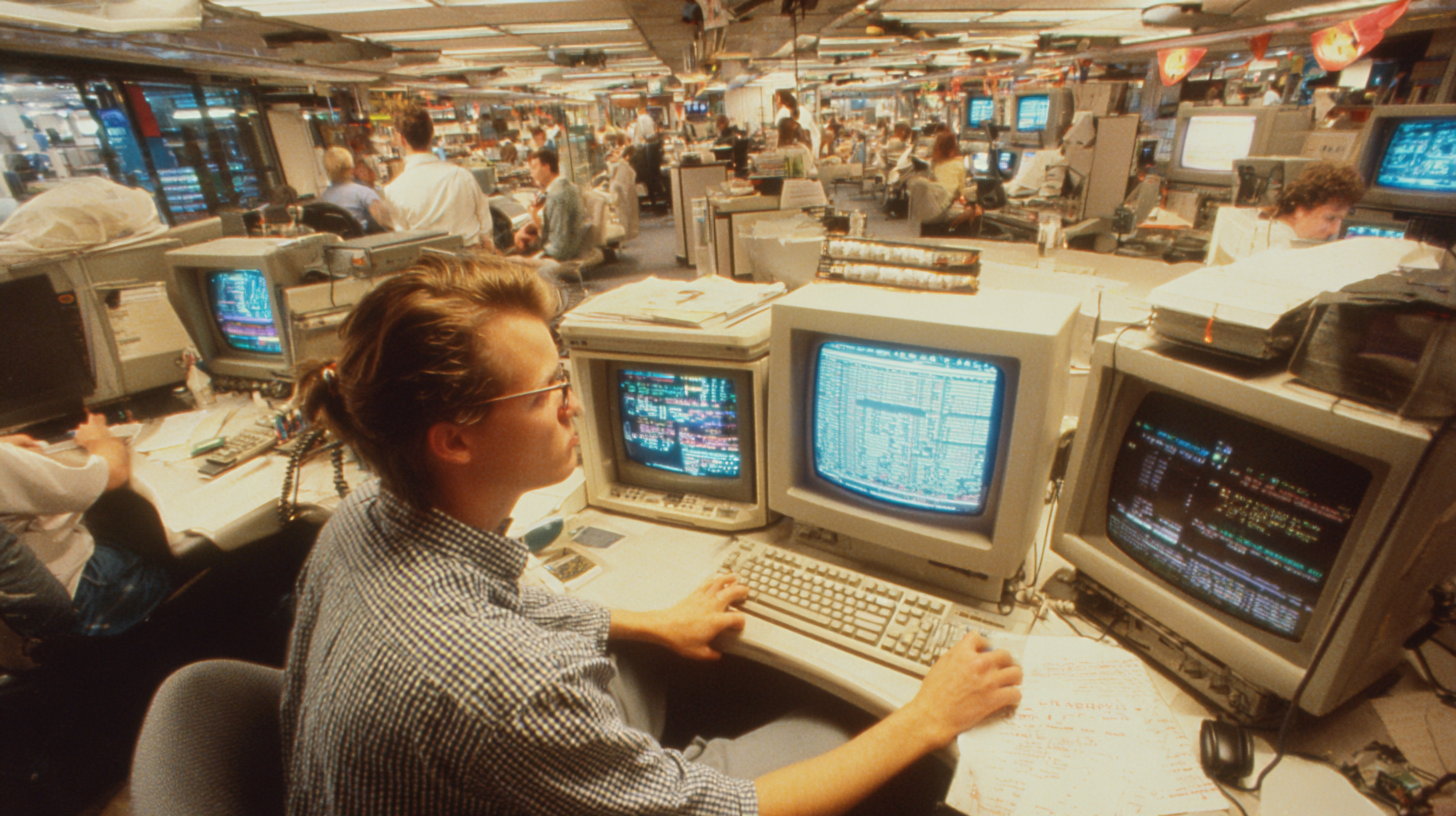
Remembering the Web Master — RIP: Why AI Is the Internet Boom All Over Again
A Moment of Silence, Please.
We gather here today to honor the memory of a fallen hero.
The Web Master.
Born sometime in the mid-90s, in a dimly lit office that smelled like burnt coffee and ethernet cables. Died... quietly... around 2010, when someone finally realized that one person probably shouldn't be responsible for designing the website, coding the website, hosting the website, maintaining the database, managing the servers, AND explaining to Karen from accounting why she can't use Comic Sans on the company homepage.
For those of you too young to remember — and honestly, bless you for that — the "Web Master" was the single greatest job title inflation in the history of employment. It sounded like you commanded the internet itself. Like you sat on a throne made of routers, directing web traffic with a wave of your hand.
In reality? You were fourteen people crammed into one body with one salary and a vague sense that something was always on fire.
UX Designer. UI Designer. Frontend Developer. Backend Developer. Web Designer. Database Administrator. DevOps Engineer. QA Tester. SEO Specialist. The person who unjams the printer. The person everyone calls when the WiFi goes out even though THAT IS NOT YOUR JOB, TODD.
RIP. You were too much for this world. Literally.
"The Internet Is Just a Fad"
I was there for the birth of the internet era. And I don't mean "I had AOL" — I mean I was IN IT, building things, watching the whole world argue about whether this "world wide web" thing was going to stick around.
The hot takes were spectacular:
🔥 "It's a fad. Give it five years." — (It's been 30. We're still here.)
🔥 "Nobody is going to shop online. I need to TOUCH the sweater before I buy it." — (Amazon just delivered a sweater to my door in 4 hours. I didn't touch it. It's fine.)
🔥 "This will destroy the entire workforce!" — (It created an entirely new one instead.)
🔥 "Y2K is going to end civilization!" — (My neighbor literally stockpiled canned beans and a generator. On January 1st, 2000, he had 400 cans of kidney beans and zero apocalypse. His chili game was strong for the next three years though.)
The dot-com boom was the Wild Wild West. People were getting venture capital funding for websites that sold dog food online. Companies with no revenue were valued at billions. Everyone either thought they were about to become a millionaire or that society was collapsing.
And then... it all settled. The dust cleared. The workforce didn't die — it evolved. The Web Master didn't disappear — they split into an entire ecosystem of specialized, well-paid careers. The people who adapted thrived. The people who insisted the internet was a fad are now... well... they're probably fine, but they definitely missed out.
Welcome to the Sequel Nobody Asked For
Fast forward to right now, and we're living through the exact same movie with a different title.
"The Internet Will Destroy Us" has been rebranded to "AI Will Destroy Us" — same plot, updated special effects.
The hot takes are BACK:
🤖 "AI is going to replace everyone!"
🤖 "We'll all be unemployed by 2027!"
🤖 "I asked ChatGPT to write my resume and it listed 'Proficient in Microsoft Clippy' as a core competency."
🤖 "My boss used AI to write a company-wide email and it started with 'As a large language model, I...' — nobody tell him."
Look. I've been in tech for over 20 years. I have survived:
✅ The internet boom (and bust)
✅ The mobile revolution ("Apps will kill websites!")
✅ The cloud migration ("Nobody will own servers anymore!" ...okay that one was accurate)
✅ The blockchain hype cycle ("Everything will be decentralized!" ...still waiting)
✅ The NFT era (We don't talk about the NFT era.)
✅ And now, the AI apocalypse
Every. Single. Time. The chorus is the same: "This is the one that ends us."
And every. single. time. It doesn't.
What DOES happen? The people who lean in — who learn the thing, experiment with the thing, integrate the thing into how they work — those people don't just survive.
They run laps around everyone else.
The Part Where We Get Serious (But Only for a Minute)
Okay, comedy break over. Let me hit you with the real talk.
AI is not going to take your job.
But — and this is the part people skip over — someone who knows how to use AI absolutely might.
Picture this:
Two project managers walk into a meeting. (This isn't the start of a joke, I promise. Okay, maybe it is.)
PM #1 spent four hours manually building a competitive analysis. They're exhausted. Their eyes are glazing over. They have seventeen browser tabs open and a stress headache that could register on the Richter scale.
PM #2 used AI to do the research and heavy lifting in 30 minutes. Then they spent the remaining three and a half hours actually thinking — analyzing the patterns, building a strategy, finding insights that PM #1 was too buried in spreadsheets to notice.
They walk into the same meeting. Same topic. Same deliverable.
One of them sounds strategic. The other one sounds tired.
Guess who's getting the promotion?
This isn't hypothetical. This is happening in every industry, in every company, right now. The gap isn't between "people" and "AI." It's between people who use AI as a force multiplier and people who are still arguing about whether using it is "cheating."
(Hot take: Using a calculator wasn't cheating either, but I guarantee you someone threw a fit about it in 1972.)
The Skills Game Has Changed. Your Playbook Should Too.
Here's what I see every day building ViaSkill:
The old career playbook was simple. Learn a skill. Put it on your resume. Get a job. Repeat every 3-5 years when you need a raise.
That playbook is dead. It died somewhere between "Web Master" and "Prompt Engineer" — two job titles that would make absolutely zero sense to someone from 1990.
Today, skills evolve faster than resumes can keep up. The half-life of a technical skill is shorter than ever. And your ability to prove what you can do — not just claim it — is becoming the difference between getting hired and getting ghosted.
Think about it:
Old world: "I have 10 years of experience in marketing." New world: "I increased qualified leads 40% by integrating AI-driven audience segmentation into our existing pipeline, and here's the proof."
Which one gets the interview?
This is exactly why we built ViaSkill as a Career Operating System — not another resume builder, not another LinkedIn profile optimizer, not another "skills assessment" that asks you to rate yourself 1-5 on Microsoft Excel (we've all put 4, and we all know that's generous).
ViaSkill captures your skills as you develop them. In real time. Continuously. So when the market shifts — and it WILL shift — you have a living, breathing record of what you can actually do. Not what you did five years ago. Not a static PDF that's been sitting in your Google Drive collecting digital dust since 2021.
Your career is a moving target. Your tools should be too.
What You Should Actually Do (Starting Today)
I'm not going to give you a 47-step framework. Here's the short version:
1. Start using AI. Today. Not "soon." TODAY. Open ChatGPT, Claude, Gemini — whatever. Use it in your actual job. Draft an email. Analyze some data. Brainstorm ideas. Summarize a meeting. Just START. The learning curve is a speed bump, not a cliff.
2. Document everything you're learning. Every new AI workflow you figure out is a skill that 90% of your peers haven't developed yet. Don't just learn it — capture it. (Hey, we know a platform that does exactly that. 😉)
3. Stay curious. Ditch the fear. The Web Masters who thrived in the early 2000s didn't panic when their one title split into twelve. They picked a lane, went deep, and kept evolving. You can do the same thing — the lane is just different now.
4. Build your proof. In an AI-augmented world, everyone can produce output. EVERYONE. The differentiator is no longer "can you do the work." It's "can you think, strategize, and make decisions that AI can't?" And more importantly — can you PROVE it?
Long Live the Web Master (In Spirit)
The Web Master is gone.
Poured into fourteen different LinkedIn job titles across six different departments. Their legacy lives on every time a UX Designer and a Backend Developer have a turf war about whose responsibility the login page is.
But here's what the Web Master taught us: massive technological shifts don't end careers. They transform them. The people who leaned in got the best version of the future. The ones who resisted... got left behind.
AI is that moment. Right now. Today.
You can be the person who evolves. Or you can be the person who swore they'd never need an email address in 1998.
(That person eventually got an email address. In 2004. It was something like [email protected]. Don't be that person.)
Ready to future-proof your career? ViaSkill is the first AI-powered Career Operating System — built to help you capture, prove, and evolve your skills in real time.
Because if the Web Master taught us anything, it's that standing still is not an option.